On January 20, 1942, the so-called Wannsee Conference took place. Reportedly, the decision to kill all European Jews was adopted at the conference, and a respective implementation plan was discussed.
In Western Volhynia, as well as in other places, preparations for a new wave of mass murders began as soon as the following month. In May 1942, the first shootings of Jews imprisoned in ghettos took place in Kivertsi, Dubno, Korets, Kozyn, Verba, and Klevan; the last shootings were conducted in October in Zdolbuniv, Mizoch, and Ostroh. Labour camps were being liquidated as well. Mass shootings were mostly carried out near cities or towns containing ghettos or forced labour camps. In rare cases, prisoners were transported over long distances, as was the case with the Jews of Rivne, who were taken to a forest near Kostopil on July 13, 1942, and killed there.
“Together with two German SS men, I got into one of the cars and took the prisoners outside of the village of Staromylsk. A kilometre outside the village of Staromylsk in the Zdolbuniv district, near the cemetery, a pit had been prepared. I saw with my own eyes how the German SS men stripped Soviet citizens naked, children too, took them to the pit in groups of five, and made them lie face down. The two SS men proceeded to shoot them with machine guns…That same evening, in one car with German gendarmes and policemen, I left the town of Zdolbuniv for the town of Mizoch; it was already dark in the evening. Together with the gendarmes and policemen, we went to an area behind the Mizoch sugar factory.When we arrived at the indicated place, about 500 people, Soviet citizens of Jewish nationality, were sitting in the ditch. The German gendarmes assigned me and other police officers to guard the people condemned to death, and I guarded them, armed with a rifle. In the morning, early at dawn, SS men arrived in two cars. The people condemned to death were driven out of the ditch and ordered to undress. Then, in groups of five, they were driven into the pit, where they were ordered to lie face down. Two SS men stood right there, in the pit, and shot them with machine guns”.
Adam Prokopchuk,
a Ukrainian from Derman Pershyi, served in the local police force in Zdolbuniv at the age of 27
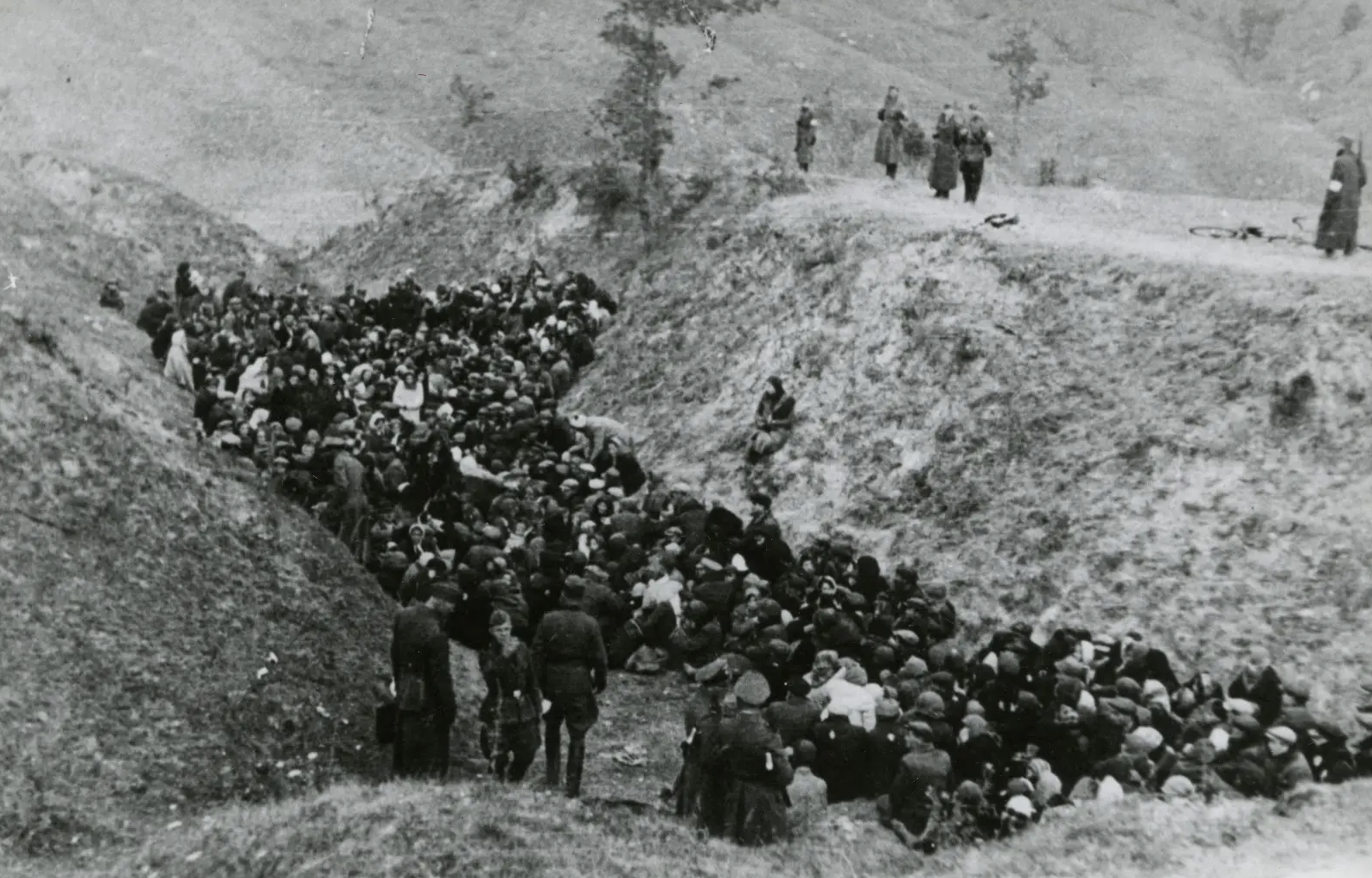
Before the mass murder of the Mizoch Jews. Source: the United States Holocaust Memorial Museum.
By the end of 1942, only one official place for the detention of Jews remained in Western Volhynia: the ghetto in Volodymyr. It held about a thousand Jews: artisans deemed valuable by the Nazi authorities and escapees from liquidated ghettos. Eventually, on December 13, 1943, all its prisoners were shot. In total, about 160 thousand Jews were killed in Western Volhynia during the period.
Only a few people managed to escape on the eve or during the shooting. Escape attempts occurred while Jews were being escorted to the shooting sites. Throwing themselves at the guards and distracting their attention, they enabled relatives to escape at the cost of their own lives. Jews fled from the shooting sites at random, hid in prearranged hideouts, ran to the forest, or found shelter with local villagers.
“...I was sent to a labour camp in Tynne. However, I didn’t stay there long. One night, they liquidated the labour camp. One of the Germans knocked on the window and told us to run away, or they would kill all of us. We ran to the forest. I remember there were about 8 of us girls. As we ran to the forest, we were followed by Ukrainian police. They shot and killed most of us. When my turn came, I said, ‘Don’t kill me, I have gold’ (my father and mother left it with me). The policeman said, ‘Give it to me’. I gave him the gold. He said, ‘Run away, I’ll shoot in the air’. I couldn’t believe he did it. He really did shoot in the air. That was the first time I survived’ ”.
Bernice Greenbaum,
a Jew from Zvolen, was imprisoned in the forced labour camp in Tynne as a 16-year-old
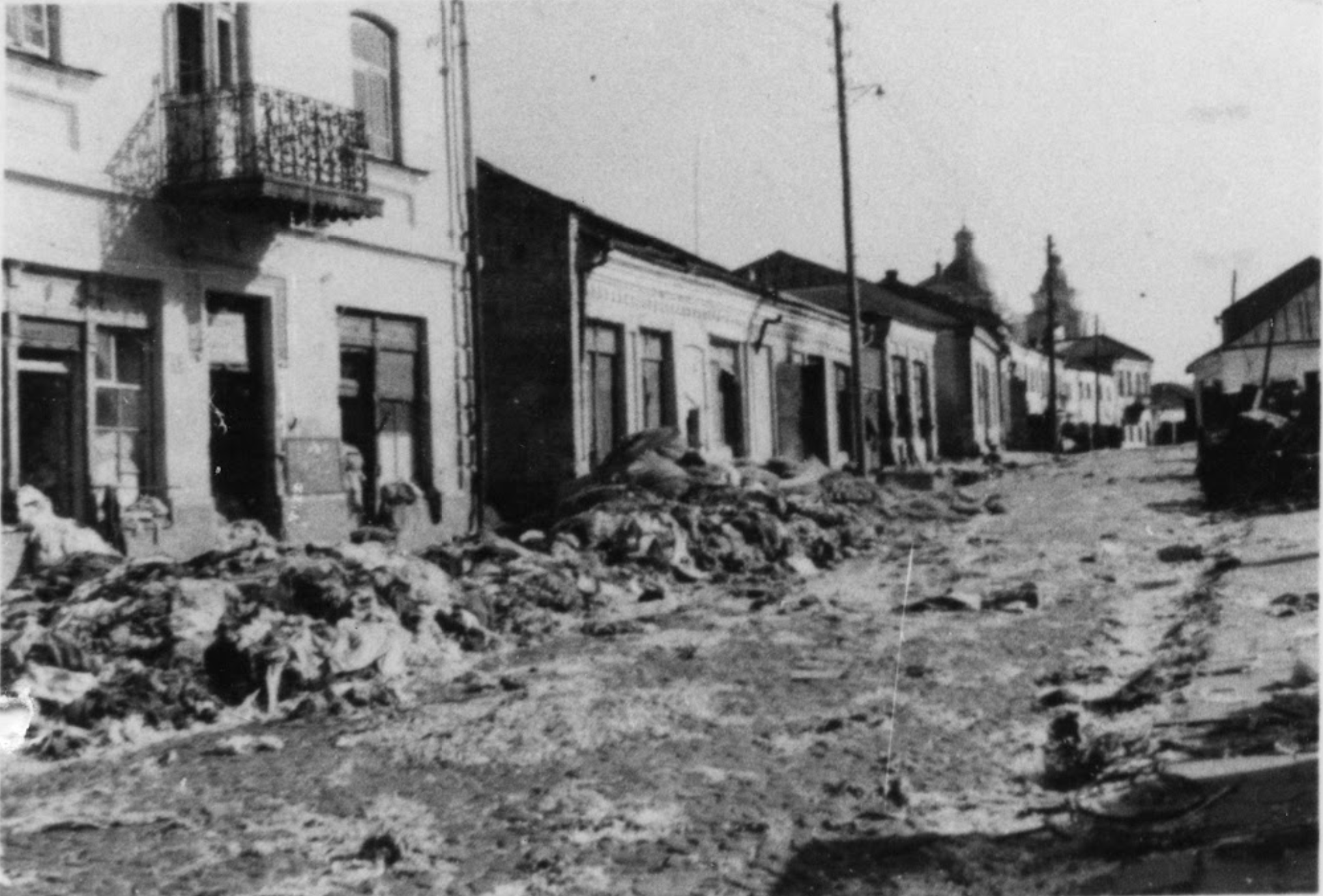
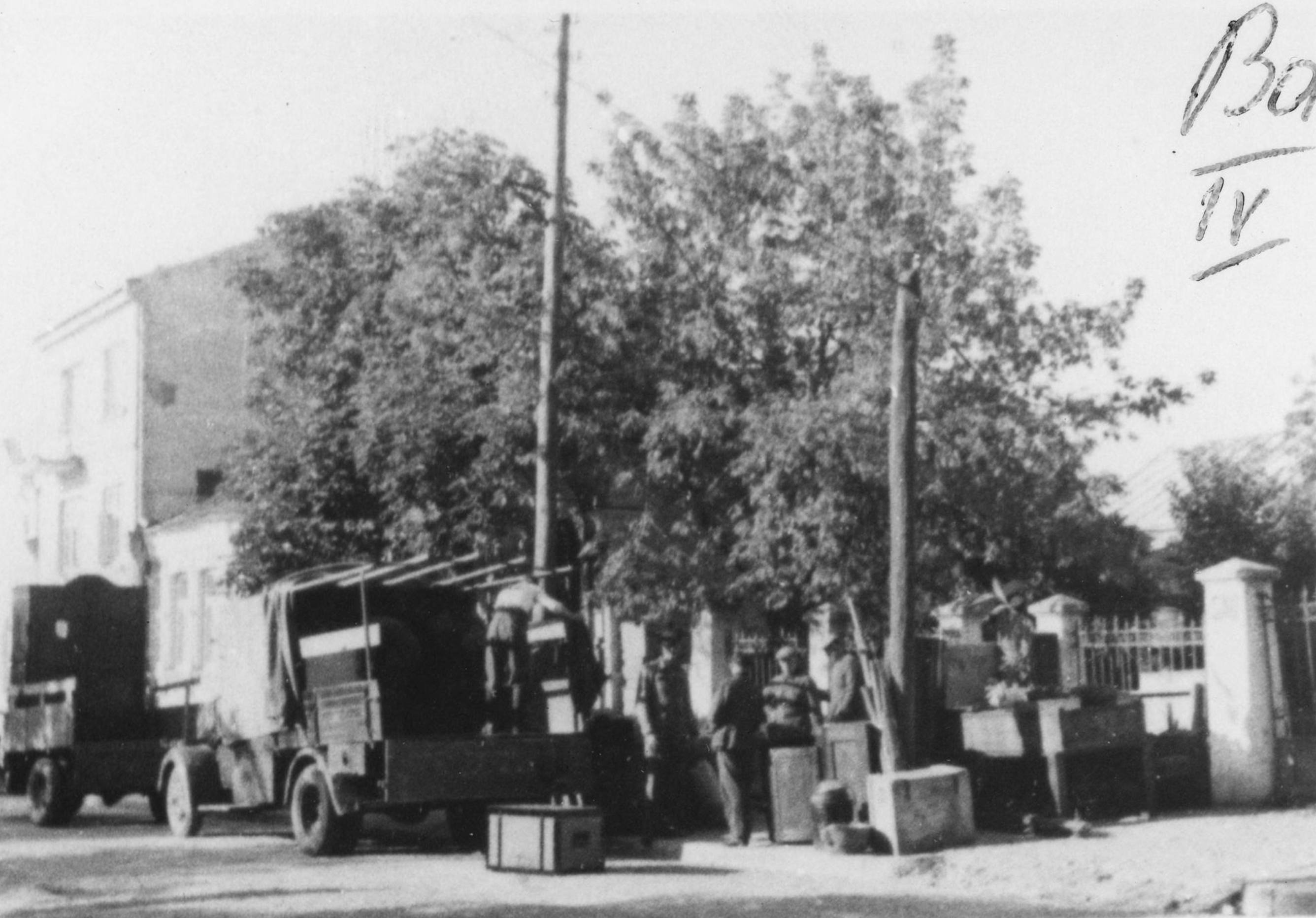
Caption: The empty ghetto in Lutsk after the massacre. Source: Bundesarchiv.
У євреїв було вкрай мало шансів чинити будь-який активний опір. За поодинокими винятками вони не мали зброї. Багато громад втратили активних лідерів, здатних організувати боротьбу, під час радянських репресій та першої хвилі масових вбивств. Підтримки з боку рухів спротиву або ж зовсім не було, або вона була не достатньою. Попри це, відбулося кілька спроб організованого опору, як-от у Мізочі та Кременці, а в Тучині, в результаті підпалу гетто та стрілянини в бік охоронців, вдалося втекти більшості бранців цього гетто – 2 000 євреїв. Утім, частіше втечі організовували ще до початку масових убивств, у момент, коли тільки ширилися чутки про них.
“People went from house to house and distributed cans of kerosene, according to the Judenrat instructions. My brothers, Davyd and Lova, took part in this, too. Other men also had weapons. In addition, they also distributed weapons that they had prepared in the Judenrat in advance. They planned everything in one day. My father and Himelfarb stayed in touch with these young men. On Monday night, no one went to bed. People sat in their houses and waited for the signal. When the first house caught fire, all Jews came out of their homes. They doused their houses with kerosene and set them on fire. The ghetto went up in flames. The scene is difficult to describe. The noise and commotion were extraordinary. Women were looking for their husbands, children for their fathers. Bitter weeping and shouts of ‘Sh’ma Yisrael!’, and amidst the commotion young people started shooting at the Germans and Ukrainians and throwing grenades”.
Miriam Shvartsman-Kotz, a Jew from Tuchyn, daughter of Herschel Shvartsman, who was the head of the Judenrat and led the uprising in the local ghetto
Alongside the mass murder of the Jewish population, the Roma were also executed by firing squads, in particular in Kamin-Kashyrskyi, Kovel, Lokachi, Sarny and Ratne. Initially, the occupation authorities’ policy towards the Roma population was not consistent; still, more than 1,200 Roma perished in the course of the genocide in Western Volhynia. Very little is known about the number of people with mental illnesses killed during the period and about the policy adopted towards them in the region.