According to Israeli researcher Shmuel Spector, there were only 2,836 Jews left in Volhynia after the Holocaust. Most of the surviving Jews had nowhere and no one to return to.
“The whole town was demolished. Every single house… They sold all the houses. As far as I understand, they sold all the houses to villagers, and the latter proceeded to take the houses apart. There were about 6 or 7 houses left, including ours. Russian police were there. We really wanted to see what had happened to the town. We wondered what had happened there and whether there was anyone left there. But there was no one left. No one”.
Nathan Peters, a Jew from Ostrozhets, a Holocaust survivor, was 14 years old at the end of the Nazi occupation..
As recorded in the testimony in reference to Soviet police.
Soviet authorities encouraged the departure of Jews, as well as Poles, to Poland, in the hope that a monoethnic region would be easier to control. As a rule, Jews who decided to move further away emigrated to Germany, the USA, Canada, and later to Israel. Those who opted to stay in the Soviet Union tried to move to bigger cities or other regions.
“Before my parents left Poland (when they were already ready to leave Poland), they approached Vasylyna and Oleksandr and said: ‘We are leaving. Poland is rich with the blood of our entire family. The earth here smells of blood. There is nothing left for us to do here, we have no one [related to us] left here. Come with us and we will treat you like our parents, and our daughter will have both us and you for parents. We will take care of you’. Vasylyna and Oleksandr considered this for some time. In the end, they said: ‘We have thought about it. We are old; our families are here, our farm is here, everything we have is here. We cannot adjust as quickly as you. Knowing that you are going to the USA, we might consider doing it'. However, my parents did not know where exactly they would end up, so Vasylyna and Oleksandr refused to go with them. My parents left, and they stayed”.
Marsha Tishler, a Jew from Holoby who survived the Holocaust, was 2 years old at the end of the Nazi occupation..
As recorded in the testimony in reference to Western Volhynia, which until World War II was part of the Polish state.
Trials of the top leadership of Nazi Germany, SS and police officers, and the military high command began almost immediately after the end of the war. They resulted in the executions of several hundred senior and mid-level officials. A much larger number of perpetrators, though, received long prison sentences. Many trials took place long after the end of WWII. In some cases, however, criminals received lenient sentences, were granted amnesty shortly after the sentencing, or avoided punishment altogether.
The conventional practices of the justice system had to be revised. This gave impetus to the establishment of a new system of post-war justice, with “transitional justice” as one of its cornerstones. Transitional justice defines the ways of overcoming the problem of large-scale and/or systematic violations of human rights in countries where a war and/or repressions took place. Its key components are accountability and prevention of impunity; compensations for victims; the right to the truth; restoration of public trust; measures aimed at preventing the recurrence of crimes in the future.
Closely interconnected, these components form a complex vision of justice understood as more than just trials. The first Frankfurt trial of the Auschwitz concentration camp guards in the 1960s provides an illustration of the concept. While the trial resulted in only 17 guilty verdicts (despite the fact that the concentration camp in question employed about 7 thousand functionaries), it had enormous impact on society. With this judicial process, the Holocaust entered the collective memory of the Germans as well as, slightly later, the collective memory of most Western European societies.
In the Soviet Union, justice had its own peculiarities. The authorities sought to punish Nazi accomplices as severely as possible, making this the foundation of the new Soviet identity policy. The first trials took place immediately after the return of the Soviet regime; some of them ended with public executions. Three local policemen from Melnytsia, Oleksandr Kozlovskyi, Oleksii Koval and Andrii Mykhaliuk, were tried both for their participation in the murders of Jews and for serving in the Ukrainian Insurgent Army. In July 1944, they were found guilty and sentenced to a maximum penalty: execution with confiscation of property.
From 1944 onwards, Western Volhynia saw the rise of a new wave of Soviet violence against anyone considered disloyal, regardless of whether they actually played an active role in the resistance. Many recent victims of Nazism, including Jewish survivors and their rescuers, were arrested, imprisoned in Gulag camps, or fell victim to mass deportations.
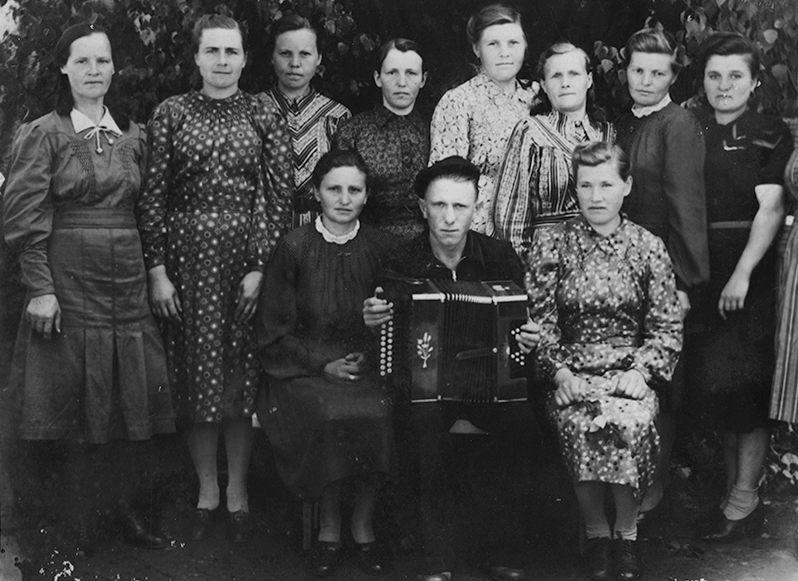
Sofiia Korotiuk (fourth from the left in the second row) in exile in Udmurtia. Source: Private archive of Hanna Honcharuk.
On November 15, 1944, Fedor Korotiuk from Richytsia, whose family saved Jewish acquaintances during the Holocaust, was sentenced to 10 years in prison. His wife Sofiia and three children were deported to Siberia a year after that. Later, Sofia was sentenced to three years in prison for attempting to escape. The family returned home in 1961. The authorities only allowed Fedir and Sofiia Korotiuk to officially register in their native village in 1968.
“Father was in hiding. They found him in the hideout and put him on trial. Thanks to the Jewish woman — she confirmed that my father had helped her — he was sentenced to ten years only. He was sent to Inta, served time there. Well, what of my mother? Imagine, she was about 26 or 27 years old, I was five, my sister was little, she was two, and my older sister was nine — and they sent us to Siberia. They loaded everyone into freight cars. Getting there by train took a very long time. They brought us to a village in Udmurtia. The village had no name, it was referred to as ‘Area 29’ ”.
Hanna Honcharuk, a Ukrainian from Richytsia, daughter of Fedir and Sofiia Korotiuk, the “Righteous Among the Nations”, was deported to Siberia at the age of 5.