On September 5, 1941, the first order decreeing the creation of Jewish ghettos in Western Volhynia was issued. It concerned settlements with at least 200 Jews.
The isolation of Jews from the rest of local population made it significantly easier for the occupation authorities to control them and exploit their labour. In total, 75 ghettos were organised in Western Volhynia.
“Around the beginning of September 1942, I received an order from Pashkevych, the district police commandant (in the city of Holoby), to gather all citizens of Jewish origin in one designated place and take them under guard. When all citizens of Jewish origin were gathered in the ‘ghetto’, I ordered to surround Bozhychna Street and to keep the place under constant armed guard. According to the instructions, it was strictly forbidden to go outside the camp (‘ghetto’)...”
Oleksii Koval, a Ukrainian from Melnytsia, held the position of a local police commandant at the age of 28.
Most ghettos were set up in the poorest areas of towns and villages. When relocating there, Jews were given limited time for moving their things to a new place: several weeks, days, or even a few hours. The less time the Jews had, the fewer things they managed to bring with them, which then made their everyday life much harder.
“…[the village elder of Beresk] came that very day with another person and said: ‘Leave everything, take what you can take with you, and go to Kysylyn’. We asked him: ‘Do they want to kill us?’ — ‘No, you will live in the ghetto there’. My father could not carry much, because he was disabled, and my mother was not a healthy woman either, so we carried what we could. We came to the ghetto, they gave us a small room, we took the door off the hinges, brought a few chairs. We put the door on the floor, lay some down blankets on top, and that’s how all of us slept: some on the edge, some in the middle. We covered ourselves with one blanket. Then they started taking us out to work”.
Sonia Scherer, a Jew from Beresk, a 17-year-old prisoner of the Kysylyn ghetto.
Many ghettos were divided into several parts: one for artisans and other skilled workers with their families, the other for the rest of Jewish population. The largest ghettos existed in Volodymyr (15–18 thousand Jews), Lutsk (14–15 thousand), Kovel (over 13 thousand). The smallest ghettos were set up in Povorsk (about 200 Jews) and Chetvertnia (no more than 100). People died almost every day: from malnutrition, infectious diseases, hard labour, beatings, and regular executions.
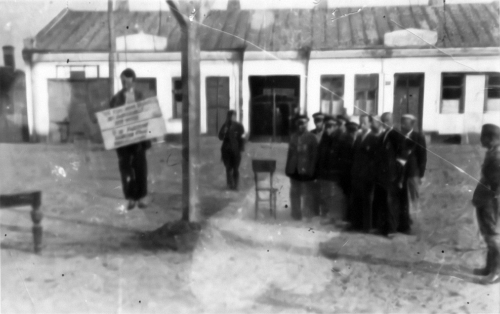
Execution of a Jew from the Zdolbuniv ghetto under the supervision of German gendarmerie officers, local police, and Jewish security forces.
Source: the Yad Vashem Archives.
“I went there, to the ghetto. I brought food to Yosko. There was this guy, Yosko Langer. He and my father were kind of friends. He had a wife, Sura, who helped with the harvest. When they started forcing everyone into the ghetto, she stayed with us. So I brought food in the evening. There was wire, but what of it! There were six lines of wire. One could bend down and crawl under if needed. Mother even carried my youngest sister there during the harvest so that they watched her”.
Pinchas Blitt, a Jew from Kortelisy, was imprisoned in the Ratne ghetto when he was 11 years old.
“Many Jews from the town of Ratne gave their children to the villagers they knew. I was one of such children. There was this woman, a widow; she had a daughter and a son. The son was 15-16 years old. He regularly beat me; he beat me, but I had food and slept on the hay in the barn. Sleeping on the hay, by the way, is very nice. It is very nice. Better than sleeping in a bed, trust me”.
Serhii Romaniuk, a 12-year-old Ukrainian from Kysylyn.
To maximise the exploitation of the Jewish workforce, the Nazi authorities also created 26 forced labour camps in Western Volhynia. Selecting people for such camps was entrusted to Jewish community leaders. In the camps, conditions were often harsher than in the ghettos.
watch video