The Jews who had managed to survive mass killings used four main strategies to ensure further survival: hiding in the woods, seeking assistance from non-Jewish neighbours, using forged documents to conceal identity, or asking partisan units for help. The majority of surviving Jews had to resort to all of these strategies at different stages of their survival journey.
Most often, the survivors hid in the forest. While living there, Jews sometimes formed “survival groups”, building dugouts, creating self-defence units and jointly searching for food and clothing, which were crucial for their survival in such conditions.
“We made a dugout in a hole. But we could not dig deeper than knee-deep, because further down there was a rocky surface. We put thick birch trees on top and made just one opening for getting in and out. Inside one could only lie down, not sit or stand. With snow covering it on the top, the dugout was quite well hidden, but in the evening, when 33 people climbed in, although some stood guard, we had to lie on top of each other, neither alive nor dead. At first, we used snow as water; later we dug a hole and got dirty water to sustain our existence. During the day we cooked on a small fire, and in the evening we went to search for food. Once we brought back 2 sheep we had caught in the valley; we slaughtered them and brought to the forest. Another time we came back with potatoes, boiled the potatoes without peeling them, and gave two potatoes to each person. Bread was a luxury”.
Yehuda Kogan, a Jew from Birky, survived the liquidation of the Ratne ghetto at the age of 20.
Many Jews tried to enlist the assistance of their non-Jewish neighbours, but the latter, due to denunciations, constant searches and raids, and a general atmosphere of fear and distrust, did not always agree to help. On top of that, the occupation authorities threatened the local population with various punishments — including the execution of offenders and their families — for aiding Jews in any way.
“Vasylyna and Oleksandr took care of me for about two and a half years. One day, Vasylyna and Oleksandr received a letter (a very official document) that ordered to deliver me, on a certain date, to a neighbouring town. Vasylyna hurried to Adam [the village elder] and asked: ‘What should I do?’ He replied: ‘You have to go, otherwise they will come and kill you’. She arrived very late and said that the wheel on her cart had broken, or something to that effect. By the time she arrived, all the children who had been gathered there had already been shot. She started arguing with the captain, who was very angry with her and ready to shoot me. She said: ‘Shoot me first’. However, he was not ready to kill Ukrainians, because he himself was a member of the Ukrainian police. They were not Germans. So he said: “Take her home; you will bring her next time’. That’s how she saved me that time”.
Marsha Tishler, a Jew from Holoby, was less than one year old when the local ghetto got liquidated. She was saved by Oleksandr and Vasylyna Yarmoliuk, a couple honoured as Righteous Among the Nations.
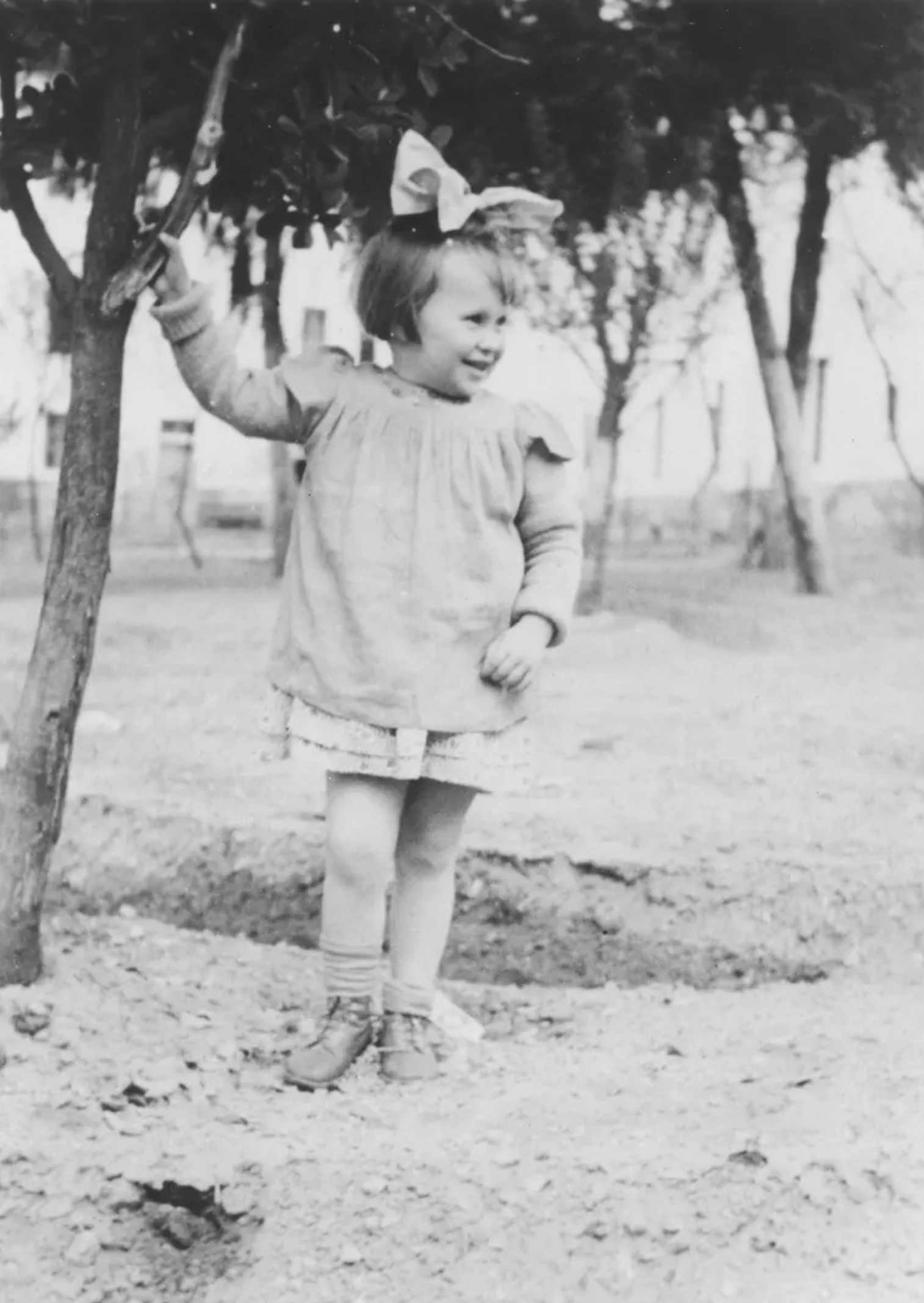
Marsha Tishler at the end of World War II. Source: the United States Holocaust Memorial Museum.
As recorded in the testimony in reference to the commandant of the local police.
Yakіv Sukhenko and Ivan Shevchenko, who helped many Jews from Rivne and Zdolbuniv by providing them with false documents and organizing their escape to other regions of Ukraine, were eventually exposed and shot in April 1943 in Kyiv. Despite everything, there were more people willing to risk their lives.
Sometimes, they acted absolutely selflessly; in other cases, their assistance was motivated by material gain. In our time, the Yad Vashem memorial in Israel awards the honorary title of “Righteous Among the Nations” to rescuers whose actions are deemed irreproachable. According to the latest data, the title of “Righteous Among the Nations” has been awarded to 2,691 people from Ukraine; of these, several hundred are from Western Volhynia. Most recently, in 2022, this title was awarded, among others, to Fedir and Sofiia Korotiuk, a couple from the village of Richytsia near Tuchyn. They rescued the Jewish family of Zlotniks hiding in a dugout near the couple’s house.
Concealing one’s ethnic origin in Volhynia, a predominantly rural area mostly inhabited by Orthodox Ukrainians and Catholic Poles, constituted an extremely difficult task. False documents alone did not suffice; not knowing which Christian saint you were named after could give you away. Jews had to be intimately familiar with the religious rites, language, and customs of the community. Besides, in the countryside, where everyone knows everyone else, staying anonymous is almost impossible. Jews had a better chance of success if they attempted to pass themselves off as Poles and flee to other cities or to Germany, where they were used as forced labour. There, Jews could be sure that they would not be recognized.
The story of Khaim Sygal, a Jew who successfully passed himself off as a Ukrainian, Kyrylo Syholenko, stands out as perhaps the most unique. He became the commandant of the local police in Dubrovytsia and helped implement Holocaust policies in the region. In Volhynia, this is probably the only example of a potential Holocaust victim joining the side of the perpetrators.
Three organized underground movements were active in Volhynia: Polish, Ukrainian, and Soviet. Additionally, small partisan units without a clear political orientation emerged spontaneously. The stance each unit took on the “Jewish question” often depended on the fighters’ level of anti-Semitism or their commanders’ attitude towards Jews. Jews occasionally joined existing militia units or even formed their own. This “rescue” method was not suitable for everyone.

A group of Jews from the town of Katerburg (now Katerynivka) before execution by firing squad are guarded by German gendarmes and local police officers. Source: Archive of the USBU in the Ternopil oblast.
Незалежно від того, яку стратегію обирали вцілілі, у них було значно більше шансів загинути, ніж вижити. Одна з ключових причин – постійне «полювання на євреїв», участь у якому найбільше брали службовці німецьких жандармерій і допоміжної поліції. Саме вони виїжджали до тих місць, де, згідно з доносами, переховувалися євреї. Найчастіше вони вбивали жертв на місці, привласнюючи собі будь-які цінні речі, що їм належали.
“...I rode my bicycle to the Zastavok colony to get moonshine. On my way home, on a forest path, I met a fellow villager named Vaintrop, who was walking towards me together with her daughter. When I asked her: ‘Where are you going?’, Vaintrop replied: ‘Don’t you know that we are Jews; we are hiding so as not to be shot’.Upon hearing this, I reached for my weapon. They started begging me not to shoot them. The girl screamed, clinging to her mother, but I continued doing my job. With the first shot, I killed the woman in front of her daughter; then I fired a second shot, and the girl’s corpse fell to the ground. That’s how I shot Vaintrop and her daughter dead”.
Oleksandr Kozlovskyi,
a Ukrainian from Melnytsia, a 21-year-old local policeman active in the persecution of surviving Jews.
In some cases, people were murdered; in other cases, lives were saved. Sometimes police officers helped to rescue their Jewish acquaintances. Foresters played an important role in the “hunt” for Jews. They often walked in the woods, and therefore were among the first to discover the hiding places of Jews. They could choose to report the Jews to the police or kill the Jews themselves and take their possessions, thus eliminating a danger to their family. They could also choose to let the Jews live and even help the victims. The decisions they made were different, depending on the individual.